Information Flow | LDWA System Project Update
Updated: 01/2026
The purpose of this page is to provide information about current Leeds Domestic Waterusers (LDWA) projects, and inform the community about potential impacts during construction. Although the LDWA understands that construction creates an inconvenience, it is committed to keeping the community informed.
Construction Project Updates
BACKGROUND :: LDWA currently gets its water from Oak Grove Spring and Highland Well. The water from the spring is shared with the Leeds Water Company (LWC) irrigation company. LDWA’s portion amounts to averages of about 120 gallons per minute. The well can produce approximately 335 gallons per minute. The total average source capacity adds up to 455 gallons per minute.
Over the years the several LDWA Boards have wisely commissioned a number of Water Capacity Studies to be completed, by multiple consulting engineers, on the system. In each of the last four studies (2007, 2015, 2017 & 2021), it was identified that the LDWA is deficient in source when using the State of Utah Drinking Water guidelines. It has been recommended that a new well location and well in the amount of 700 gallons per minute be secured, drilled, and developed.
In 2010 a Loan was secured by the LDWA, and a project scoped out within it was the drilling of a new well. Unfortunately, after 2 failed attempts to locate a suitable location, this project was terminated.
UPDATE :: The current well project has been divided into 2 parts: A) the well drilling/construction and B) the well house, backup generators, new well equipment, chlorinator, and altitude valve. Also, rather than drilling a pilot hole, it was suggested by our consulting professionals that increasing the capacity of the existing well so as to determine the strength of the aquifer would be the best approach to locating the new well. This was done with great success, increasing our current well capacity to 600gpm the allowing the new well to be located nearby, due to the unique capacity of the aquifer beneath the existing well.
UPDATE :: JANUARY 2026: Well drilling and Main St West line complete and projects separated into 4 parts.
 Utah Division of Drinking Water, State Revolving Fund (SRF) Package
On August 31, 2022, the Division of Drinking Water (DDW) Board met and authorized a loan of $7,519,500, with $3,499,500 principal forgiveness to LDWA for drilling a new well, installing a chlorinator, installing an altitude control valve and vault, replacing 4,500 feet of water main and transmission line replacement. The loan terms offered to the LDWA are forty (40) years, at an annual Interest Rate of 0%.
 PROJECT 1 OVERVIEW :: New Well
Project #1A – Well Drilling The drilling portion of the new well is complete. The new well reached a depth of 600’ into the existing aquifer. Testing of the new well produced 330 gallons of water per minute with 30’ of drawn down. Since the existing well and new well share an aquafer, draw down was tested at both wells when the new well was pumping. Draw down at the old well was measured at 2’ while the new well runs at full capacity. This testing shows minimal impact on the old well while the new well operates and there is no reduction of water supply from the old well.
- BLM final permitting was approved with full categorical exclusion prior to well drilling.
- After some turnover at the Paiute Tribe administration, a new relationship was established with the Paiute Tribe Cultural Resource Manager. All archaeological work and cultural monitoring to wrap up in February 2026.
- LDWA has successfully submitted change applications to use all underground water rights at both well sources. This includes a separate change application to segregate from unusable sources located at Sand Hollow reservoir.
Project #1B – Well Equipping, Well House Construction of the well house, controls, SCADA (automated data collection, monitoring, and control), back up generator, and site cleanup estimated to begin in the spring of 2026 and be finished in 2027
STATUS :: INPROGRESS

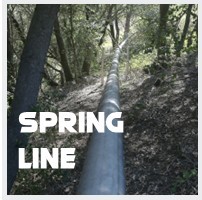 PROJECT 2 OVERVIEW :: Oak Grove Spring Transmission Line Replacement
BACKGROUND :: Our Spring capture basin and 4” steel water line was constructed in 1954 at great cost and sacrifice by some amazing pioneers in this area. We owe them a great deal of thanks and admiration for their determination, grit and forward thinking. They sacrificed time, labor and money not just for themselves but for us, the future beneficiaries.
As with all things, age takes its toll and this line has reached its projected useful life. In addition, we were able to increase theOak Grove Spring flow last year by removing some of the trees surrounding Oak Grove Spring. It is projected that removing more of this water intensive vegetation and some modifications below the spring can further increase flow. LDWA water rights from the Spring is dependent on the total flow of Leeds Creek and the Spring. As agricultural land is developed it is anticipated those agricultural water rights will be transferred to allow LDWA to serve those retired lands with culinary water.
Consulting engineers have analyzed the overall conditions of the Oak Grove watertransmission pipeline as well. Their findings indicate that the 69-year old line is nearing the end of its expected service life, based on the extremely corrosive soils in and around Leeds and the typical service life of steel pipe in surrounding areas. The recent repairs to the lower portion of the Spring pipeline indicate that failure has started occurring in varying degree. Steel pipe becomes brittle with corrosion and is further vulnerable to landslides and earthquakes. As the primary year-round water source, the engineer determined that the Oak Grove and Spring transmission line should be replaced as soon as is feasible.
By replacing the current 4”, 68-year-old water line with a new larger 8” line we assure continued and possibly increased Spring water flow both now and into the future.
UPDATE :: The design of the Spring Transmission Line is 90% complete. An 8” HDPE pipe (as opposed to the existing 4” iron pipe) is proposed and will convey water from the spring collection to the Oak Grove tank. Design improvements include a large reduction of air valves, which have been difficult to maintain in the past. Also, metal boxes that are currently used to reduce the pressure of the spring line, will be replaced with buried concrete structures that are compliant with State Code. These boxes will be secured and elevated and will provide for additional means to isolate portions of the Spring Line for maintenance. The new transmission line will be located adjacent to the Oak Grove road, to improve visual inspections and maintenance. Exposed portions of the pipe will be properly buried and protected.
- 5 Miles of new transmission lines are to be installed to replace aging piping. The project includes new altitude control boxes and improved access for maintenance and monitoring.
- Permitting, studies, and monitoring with the USFS and the Paiute Tribe were thoroughly completed with archaeologists, biologists, botanists, and hydrologists. Waiting for final approval of categorical exclusion from USFS and a stream alteration permit from the Army corps of Engineers.
- Advertisement for contractor procurement to begin in Spring of 2026.
STATUS :: INPROGRESS
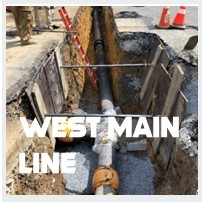 PROJECT 3 OVERVIEW :: Distribution Line Replacement [West]
BACKGROUND :: The west side Main Street main water pipeline was installed in 1976 making it 46 years old reaching its useful life for a PVC main water line. Besides being undersized for fire flow by today’s standards, the strength, wall thickness and durability of this pipe is substandard. (Class-C as opposed to superior current C-900 PVC specifications)
This line is the one connected directly to our Fire Hydrant System through the center of Town. The intent is to replace this 6” line with a 10” line to accommodate future water needs at the south end of Leeds and to meet current Fire Hydrant flow requirements for industrial, commercial, municipal and larger structures along Main Street.
Since the Washington County Water Conservancy District, WCWCD, is moving ahead to replace their failed large main water line which passes through Leeds, we have been able to work cooperatively with them to replace our line at the same time thus saving cost on shared engineering, pipe pricing (volume purchasing), trenching, asphalt replacement, and safety signage and routing. This cost savings is significant.
Having the West Side of Main Street torn up once instead of twice will not only lessen cost but reduce the time of inconvenience to the citizens of Leeds.
UPDATE :: The west Main St line was completed in December 2024 in partnership with Washington County Water Conservancy District.
- 5 miles of new 10” PVC line, along with water meter and hydrant connections were installed.
- Final cost of the Main St West Line was significantly reduced by partnering with WCWCD allowing additional funds to be used in other phases of the project.
STATUS :: COMPLETED

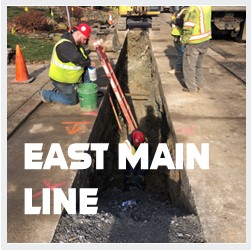
PROJECT 4 OVERVIEW :: Distribution Line Replacement [East]
BACKGROUND :: Portions of the Main Street east side water pipe line suffers from some of the same conditions as that of the west side line, however it is somewhat newer and the upper end above Vista Avenue has previously been replaced with 8” pipe. The plan on this side is to replace the older Class C, 6” water line below Vista Avenue with new 8’ line.
UPDATE :: Still to be completed, the Main St East line includes up to 1 mile of new distribution line with water meter and hydrant connection updates.
- UDOT permitting is minimal.
- This phase of the project can be scaled based on availability of funds remaining from other projects.
- Estimated to be completed in 2027.
STATUS :: INPROGRESS
Elements Completed:
- Installed a larger pump in the existing well and successfully tested the aquifer for an additional nearby well. This increased source capacity goes a long way to ensuring LDWA meets DDW criteria and existing demands.
- New well drilling and testing.
- Main St West Line. Used the existing piping with minimal connections to improve the overflow from the Highlands tank so that it is correctly routed back to Leeds Creek. This was a very efficient use of existing resources.
- A fire break was cleared for the existing and soon to be replaced well house at no cost to LDWA.